
How We Test
Every guide on ChatSelfies follows the same rules: check against the official source, write down when we checked, and say clearly what is advice versus fact.
Phone settings and menu paths
- We check every menu path (for example, where to find grid lines or the mirror setting) against the manufacturer's own help pages: Apple Support, Google's Pixel Camera help and Samsung Support.
- We link to those pages and record the date we checked them. Our current checks are dated October 13, 2026.
- Menu names change between software versions and models. When a label differs across versions (for example, Samsung's "Grid lines" becoming "Composition guide"), we list both.
- Where we haven't been able to confirm a path for a specific phone, we say "varies by model" instead of guessing.
New guides: what we check, and how we label it
- Official sources, dated. Every phone or app fact links to the official page it came from (Apple, Google, Samsung, the app developer, or the App Store or Google Play listing), with the date we checked it.
- App details. For guides about apps, we list the price, the platforms and the main privacy details, each from the official listing or the developer's own pages, with a link and the date. If a detail isn't published, we say "not stated" rather than guess.
- Screenshots are real captures, labeled. Android screens come from the official Android emulator, and each one says so ("Android emulator", the Android version and the date). Store listings and help pages are captured from the official websites, with the date. We never fake, mock up or AI-generate a screenshot, and we don't present emulator screens as a specific phone maker's software.
- Diagrams where we can't capture. We don't have every phone. Where we can't capture a screen (for example on an iPhone, or Samsung's own camera app), we use a clearly labeled diagram and leave out any detail we can't check against an official source.
- "What we checked" box. Each new guide ends with a short box listing what was checked, where (official pages, or the Android emulator and its version) and the date. If nothing was checked on a device, the box says so plainly.
- No invented results. We don't publish testing claims, statistics or quotes we can't back up. Anything unconfirmed is labeled as such or left out.
- Review before publishing. Drafts are reviewed and approved by the author before they go live.
Technique and editing advice
Advice on light, angles, poses and editing is general photography practice, not a lab measurement. We present numbers like "10-20° above eye level" or "filter at 20-40%" as starting points to adjust by eye, and we say so on the page.
AI photo apps
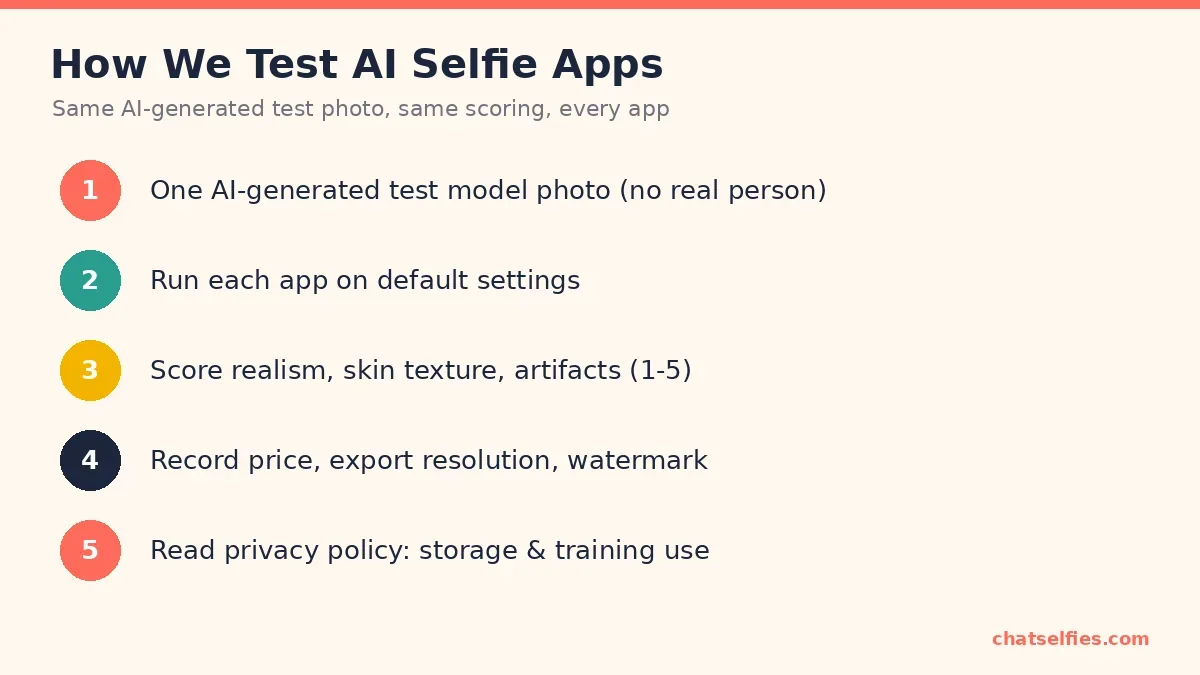
When we review AI selfie and photo apps, every app goes through the same five steps:
- One test photo. We use a single AI-generated test model photo, so no real person's face is uploaded to any app.
- Default settings. We run each app on its default settings first, so results are comparable.
- Scoring. We score realism, skin texture and visible artifacts from 1 to 5.
- The practical details. We record the price, the export resolution and whether the free version adds a watermark, using the official App Store, Google Play and pricing pages on the day we publish, with links.
- Privacy. We read the privacy policy for how long photos are stored and whether uploads are used to train AI models.
We haven't published app-by-app scores yet. Until we have, our AI apps guide sticks to what these apps do in general and the checks you should run yourself.
Independence
Companies can't pay for a better score or a mention. If we ever include affiliate links, they won't change our advice, and we'll label them as described in our affiliate disclosure.
Keeping guides current
Each guide shows the date it was last updated. When readers tell us a path has changed, we re-check it against the official source before changing the page. See our editorial policy for how we handle corrections.